
Why River Cottage Farm Raw Milk?
A Living Food
Raw milk contains essential enzymes that help you assimilate the nutrients in milk. These enzymes are the natural components that cause the milk to sour normally when certain bacteria are present.
Milk Quality
Anyone who has tasted the difference between processed and fresh raw milk needs no convincing. The full-bodied, rich flavor of raw milk speaks for itself. For a good part of the year, our cream reaches the halfway mark on a gallon, and the rest of the year, there is at least 1/3 cream.
Animal Welfare
The average cow in the US lives their entire life and produces an entire lifetime of milk in a mere 3 years. Grain feeding increases the amount of water in milk, increasing the total amount of milk to be up to 10 times higher than a grass-fed cow. Milking more than once a day uses the natural instinct of a cow to produce more milk for her offspring to increase profits for the farm.
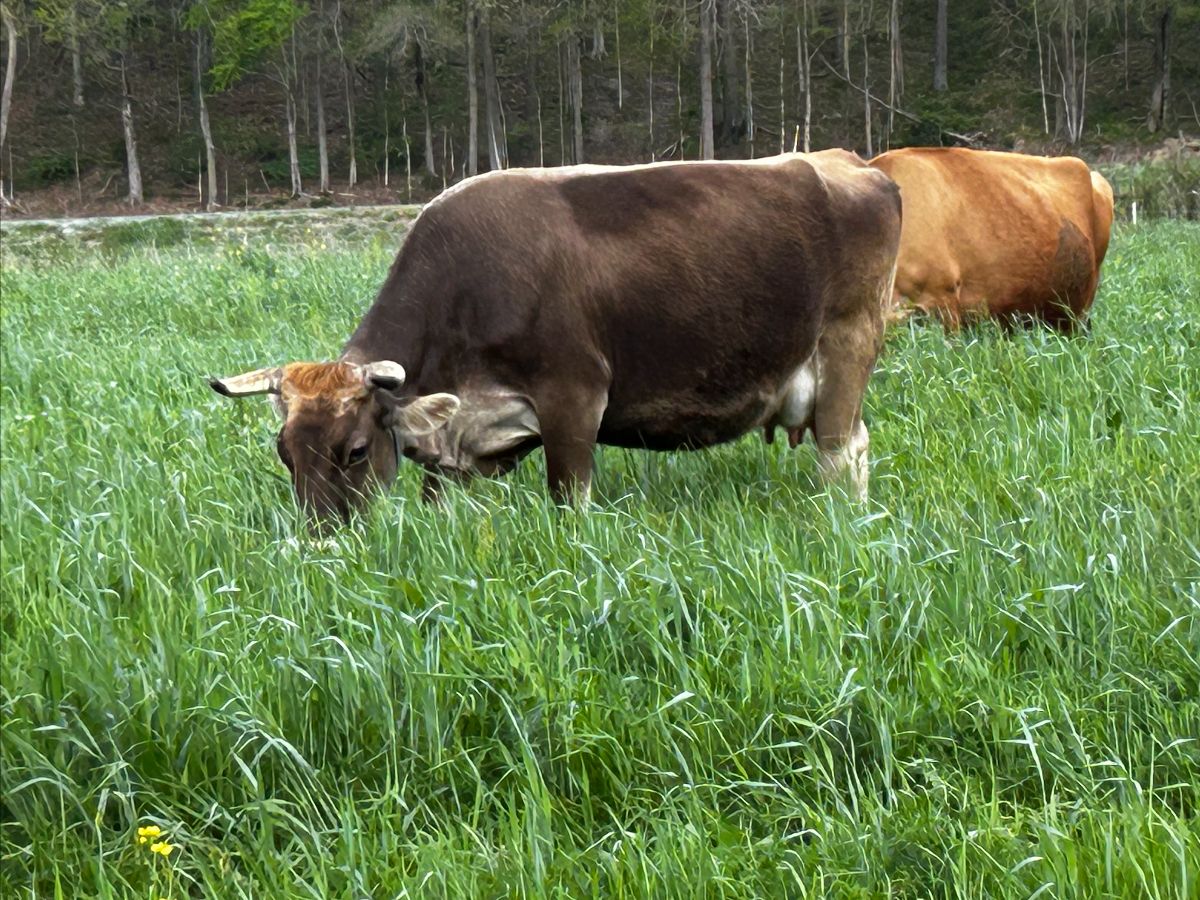
When animal welfare is placed above profit, everyone wins. The cows are healthier and live longer. Our cows live to ripe old ages on our farm, with our regenerative practices. Some have lived to be 18 years old, still milking and producing healthy calves.
You win, because the healthiest milk comes from the healthiest cows, eating the healthiest diet possible: a biodiverse diet of grass, forbs, and legumes.
How Do I Purchase Raw Milk?
To drink fresh milk in Tennessee and Kentucky, each person/family must purchase a share of one of our cows per gallon of milk. The cost of this share is a one-time fee of $30.00. Once you own your cow, you can obtain one gallon of milk for each share you own. Your per- gallon fee pays for the care, maintenance, and milking of your cow. You must sign a bill of sale and a contract before you can pick up any milk from your share. We have milk testing equipment on the farm to test our milk, and we also send out milk to an independent lab for monthly testing.
If you have questions regarding our cow boarding program, or would like to be placed on our mailing list, please email us at hello@rivercottagefarm.net
Please understand that the milk that you obtain from your cow can in no way be sold or distributed under any circumstance!
Can you tell me why I should feed my family raw milk?
No! There are many informative books and websites that you can utilize to make this critical decision. You must examine both sides of the issue and determine the best position for your family. You should visit as many websites as possible, including the Centers for Disease Control website and www.realmilk.com.
Why should my milk come from 100% Grass-fed cows?
Our goal is to produce the healthiest, best-tasting milk for your family, including taking every precaution against food-borne illness. The first and most important precaution we take is to ensure that our cattle are as healthy as possible. The health of ruminants will always be compromised when grain is introduced into the diet, no matter how little they are fed. Animals fed dry grain diets suffer from numerous gastrointestinal and other diseases. By definition, then, grain feeding means suffering for the animal. It can also mean suffering for the humans who ingest their meat, eggs, or milk. Grain feeding alters the animal's intestinal flora, increasing opportunities for the growth of pathogens such as E. coli (in cattle). Grain feeding does this by changing the pH of the lower intestine. When the intestines are at their proper pH, E. coli will be killed in the lower intestine. But when it is not, food-borne illness becomes more likely in humans.
Our cows are never kept on a
The use of grain in the diet and the practice of milking several times each day are methods of forcing the cow to produce more milk than they would naturally. We allow our cows to give us a natural amount of milk. They receive at least a two-month dry period each year and are never subjected to implanted hormones.
What do you do to ensure that the cows and the milk are pathogen-free?
Our cows were tested for T.B., Brucellosis, and Johne's disease. The milk is tested from each teat for high somatic cell counts at each milking. Your milk is also sampled monthly and sent to an independent lab for somatic cell counts, bacteria counts, and any other tests our labs feel are appropriate.
Please research both sides of this issue carefully before you decide to purchase a share in a cow. If you have any questions, please feel free to email us, and we will direct you as best we can.